Pages

Showing posts with label Space Oddities. Show all posts

Sunday, 20 December 2015

Space Oddities | Film Review | The Shining

Fig 1. "The Shining" Film Poster


Stanley Kubrick's "The Shining" (1980) is certainly one of the most iconic horror films that has been created. Kubrick creates atmosphere and a mood of terror and suspense through the use of clever camera play (see fig 2.) and a phenomenal music score; much like Kubrick's 2001: A Space Odyssey where the music plays a huge part of the film. Whereas in "The Shining" the music and supernatural themes used transform characters and settings that would seem rather lackluster into something that has a secret and more depth behind it. Not only is it these things that make for an excellent performance in "The Shining" but also "Kubrick delivers this uncertainty in a film where the actors themselves vibrate with unease" (Roger Ebert 2006) throughout the filming process add to the effect, as one example proves and says: "Nicholson was force fed endless cheese sandwiches (which he loathes) to generate a sense of inner revulsion" (Ian Nathan 2012). 


Fig 2. Danny playing with his cars on the carpet

"Instead of the cramped darkness and panicky quick editing of the standard-issue scary movie, Kubrick gives us the eerie, colossal, brilliantly lit spaces of the Overlook Hotel" (Peter Bradshaw 2012), (See Fig 3.) which is the place that Jack (Jack Nicholson) and his family move to so that Jack can be the caretaker for the winter and try to elevate his novelist career whilst he has a chance to be isolated and quiet. Right near the start of the film it is told to Jack by the hotel manager that the hotel has bared witness to a killing from the previous caretaker where he brutally murdered his wife and two daughters. Despite not being moved or affected by this Jack still decides to go on with taking the job. Maybe there's something underlying that suggests it's impossible for him to resist it? 
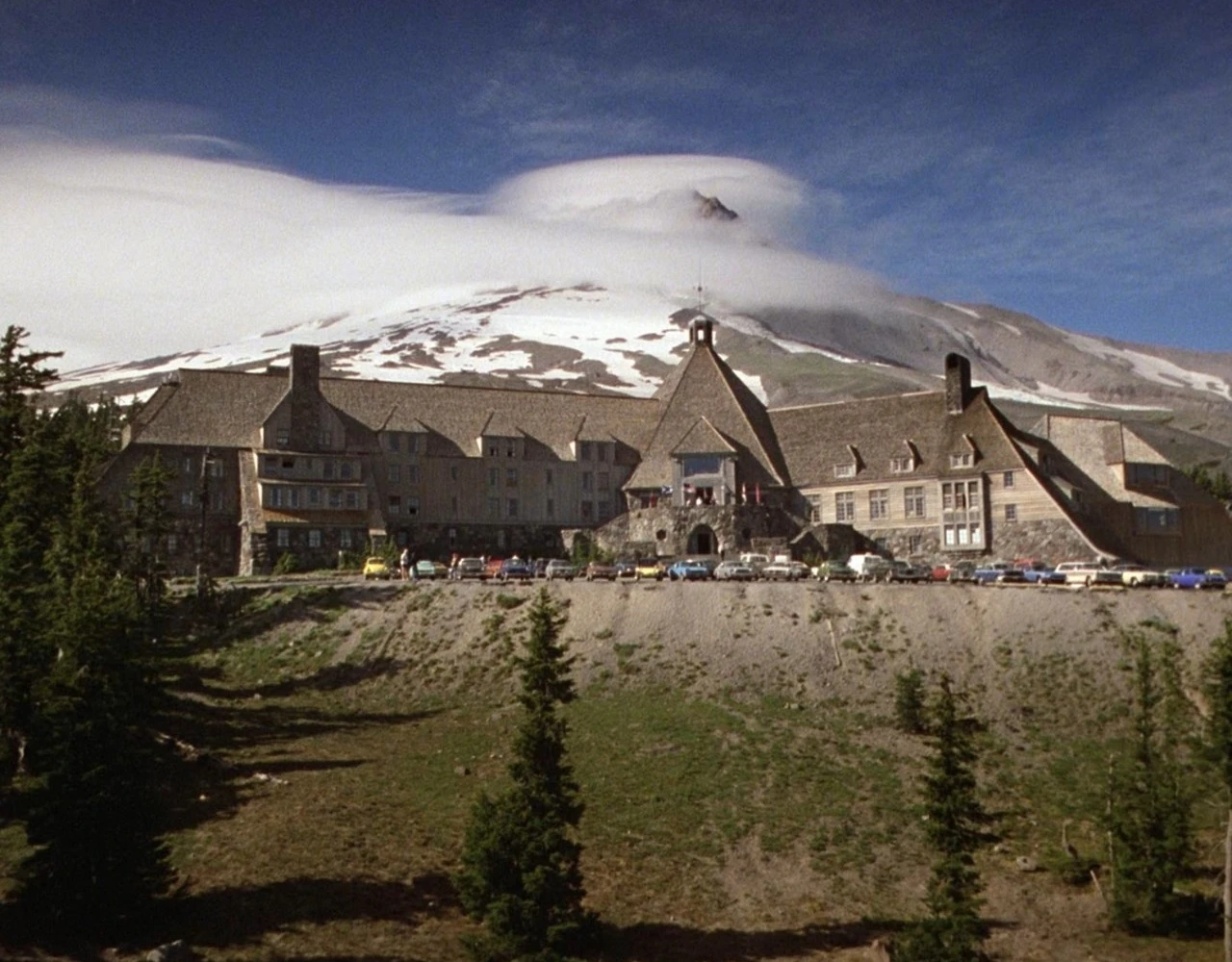
Fig 3. The Overlook Hotel


It's clear that right from the get go that the Overlook Hotel is shown as a towering monster that is so large that the character's will go insane from the isolation if not anything else. It also doesn't help when it is subtly announced that the Overlook Hotel is in fact built upon ancient Indian burial grounds and if anyone has seen "Poltergeist" we know this is a sign of bad things are going to happen inside. 
It's Kubrick's imagery and camera use that truly makes the Overlook Hotel seem like it is a beast that consumes victims, the first that sticks out is the large carpet that Danny plays with his toys on, the pattern and angle of the camera shot suggest that he is imprisoned by the carpet and his cars. Another example could be the repeated imagery of the the blood flowing out of the elevator (See Fig 4); this could represent a magnitude of things, but the one that fits the most is that the blood flowing from the elevator is the blood of all the previously slaughtered victims who have stayed at the Overlook Hotel. 

Fig 4. The iconic elevator pouring blood

Originally " The Shining" was existent on it's own as a novel written by Stephen King until Kubrick adapted his writings into a film that unfortunately didn't focus it's themes around the ones that Stephen King had created. This is why Stephen King has openly admitted that he does not like Kubrick's version of "The Shining". Although if Kubrick had adhered to the writings of King more then it is possible that the film could have made a bit more sense to the audience. This is because there is a large sense that Kubrick was unable to decide whether or not "The Shining's" story should be more of a psychological horror or a film that focused mostly on the ghost-side of things. There are many theories behind the characters and their personalities. For instance it is unforeseen as to whether or not Jack (Jack Nicholson) is possessed by whatever lurks inside the overlook hotel, be it a ghost or even a demon, he is mentally insane, he is dead and he is a poltergeist who is looking upon his past or maybe is he just simply hallucinating. Much like Danny (Danny Lloyd) who has hallucinations but instead is supposedly a psychic who is has the gift of "The Shining" meaning he can read people's minds and see the past and future. Some of Danny's "Visions" also seem to have no real relevance to the film, for example the scene where Danny sees the ghosts of two twin girls, alive and dead. 

Overall, it can be said that 'The Shining' is a marvel in the horror film world, but simply has a lot of plot holes. Whether this was intended to be by Kubrick we will never know. 

Bibliography

Quotes
Nathan, I. (2012) The Shining Review At: http://www.empireonline.com/movies/shining-2/review/ Accessed 12/12/2015

Bradshaw, P. (2012) The Shining - Review At: http://www.theguardian.com/film/2012/nov/01/the-shining-review Accessed 12/12/2015

Ebert, R. (2006) Great Movies - The Shining At: http://www.rogerebert.com/reviews/great-movie-the-shining-1980 Accessed 12/12/2015

Images

Figure 1. The Shining film poster (1980) [Poster] At: http://spartanoracle.com/8945/opinions/film-review-the-shining/ Accessed 12/12/2015

Figure 2. Danny playing with cars on the carpet (1980) [Film Screenshot] At:http://betheink.com/2012/12/homage-to-the-shining/ Accessed 12/12/2015

Figure 3. The Overlook Hotel (1980) [Film Screenshot] Athttp://stephenking.wikia.com/wiki/Overlook_Hotel Accessed 12/12/2015

Figure 4. The Elevator pouring blood (1980) [Film Screenshot] At: http://nhpr.org/post/films-greatest-elevator-scenes Accessed 12/12/2015


Wednesday, 28 October 2015

Space Oddities | Film Review | La Belle Et La Bette


                                           Fig 1. La Belle Et La Bete Film Poster 


Jean Cocteau's "La Belle Et La Bete" (1946) is a fabulous spectacle that focuses upon the gloomier side of the fairytale story that involves a young woman called "Beauty" (Josette Day) falling in love with a man who has been transformed into a tremendous yet fierce beast (Jean Marais). Unlike the Disney remake which instead focused more on the love and the magic side of the story. 


The way Beauty falls into Beast's clutches is via her selfish father, this is because he was caught stealing a rose from the Beast's garden for which he had to pay for with his death or allow one of his daughters to be taken hostage by the Beast. Beauty was the daughter who allowed herself to be sacrificed. It's not until Beauty is with the Beast that we soon start to realize that the ferociousness of the Beast is only on the outside as in fact he is a kind and gentle being. 


Fig 2. The hallway filled with candles held by human hands 

Throughout the film it is suggested that we are in some sort of magical dreamland, this fact is backed up with "When bodies appear through walls or fly up into the air, it is almost as if Cocteau's camera has miraculously recorded a dream." (Peter Bradshaw 2014). Many props within Beast's household also suggest that everything is not of this world, for example the candles on the walls are held up by human hands coming out of  the wall, the gates and doors shut automatically and also there is people who are alive within the Beast's fireplace and there is never anything said about them, they could be controlled? This question is explained with "The statues are alive, and their eyes follow the progress of the characters (are they captives of the Beast, imprisoned by spells?)."  (Roger Ebert 1999). The house that Beast owns makes us feel uneasy with a terrific use of  contrasting blacks and whites, a great example would be when Beauty is walking down a hall and the curtains are glaring bright white and flailing in the wind. The final thing that gives us an impression of nonsensicality and that we are in a dream world is the flamboyant costumes which "are exquisite affairs, glittering and imaginative, lacking only the glow of colour," (Crowther, 1947) The costumes are noticeably more theatrical when we enter the Beast's household.


Fig 3. The scene where Beast asks Beauty to marry him

After Beauty lavishes in the Beast's company she returns home to visit her Father, for she misses him. Beast agrees to set her free but for only one week for if it was any longer he would surely die of grief. When Beauty finally returns home it is clear to her family that she has gone up in the world and shows that she has richer clothing over her body. This drives her sister's bitter with jealousy causing them to create a ruse to steal the golden key which is for the treasury, and the two princes set out to go kill the beast. After some unforseeable events one of the princes climb in through the skylight for the treasury and is shot by an arrow coming from Diana. Afterwards the Beast is transformed from almost dying to a perfectly healthy prince that resembles the same appearance of the prince that died in the treasury. Beauty accepts the new prince's hand in marriage and they both float off into the sky, backing up the fact that we were surely viewing a dream this whole time. 


Fig 4. The scene where both the new converted Beast and Beauty float to the sky

This adaptation of the renowned film, is certainly one that will go down more in history as the one that has more reality behind it's meaning. The meaning of this film clearly reiterates that greedy people never prevail and that the Beast all along was trapped under a spell because of his greed.

Bibliography
http://www.theguardian.com/film/2014/jan/02/belle-et-bete-review
http://www.rogerebert.com/reviews/great-movie-beauty-and-the-beast-1946
http://www.nytimes.com/movie/review?res=EE05E7DF1738E461BC4C51DFB467838C659EDE

Image Sources 
Fig 1. http://www.20000daysonearth.com/collection/19/item/91/
Fig 2. http://mediartinnovation.com/2014/08/11/jean-cocteau-mythopoeic-movies-la-belle-et-la-bete-1946/
Fig 3. https://brendancultfilms.wordpress.com/2011/12/05/la-belle-et-la-bete1946-jeancocteau/
Fig 4. https://morestarsthanintheheavens.wordpress.com/2013/01/23/250-film-challenge-beauty-and-the-beast-foreign-450/

Thursday, 1 October 2015

Space Oddities | Film Review | Metropolis


Fig 1. Original Movie poster for Metropolis
Fritz Lang's Metropolis (1927) is a monumental film, that many films have potentially been based upon or have taken some ideas from and manipulated into their own. Nonetheless Metropolis is clearly a film that is ridden with all sorts of different imagery, including images of politics, economics and the one that sticks out the most is religious imagery.

Fig 2- A view of the higher/rich part of Metropolis

First of all the clearest vision of religious imagery is through the city of "Metropolis" and how the higher levels can be depicted as the heavens above. David Michael Wharton backs up the point nicely by saying "The sun-swept homes of the rich represent heaven, edenic pleasure gardens granting panoramic views of the city below" (David Micheal Wharton-2013) We as an audience can tell that "Metropolis" is a city that is overruled by a mass of power, this can be foretold by the use of obscure and disproportionate architecture, (which can be seen in Fig 2) which once again gives a massive image of heaven and the power that is held there. The depths below is the place in which all of the workers slave away their lives in order to keep the "higher" part of Metropolis functioning in the way that the rich are used to. Much like many other depictions of rich vs poor, the workers are place at the bottom of the city, into the place that receives no light and is generally a that is shunned and forgotten about by the higher class of residents. 
It can be argued that the workers are almost like slaves to the machines, as it can be seen within Metropolis when the evil Maria exclaims "Who is the living food for the machines in Metropolis?! Who lubricates the machine joints with their own blood?! Who feeds the machines with their own flesh?!". This proves that the working are sacrificing their own lives into the well being of the machines. 

This is where the characters come in and it can be seen that their roles can be linked to people within christian theology, the first being Jon Fredersen who is essentially the overseer of "Metropolis" he can easily be linked to god and the way god is depicted within the Old Testament, who is certainly wrathful and is quick to punish anyone who is disobedient to his orders. The second character who can clearly be linked to a large biblical character is Freder , the son of Jon Frederson. Bearing in mind it has already been discussed that Jon is a depiction of god, therefore it can be argued that Freder is a re-imagined version of Jesus Christ. The "good" version of Maria can be seen as John the Baptist, this idea comes from the scene where Maria is in the catacombs giving speeches on how a mediator is going to appear and bridge the gap between the head and hands by being the "heart". This relates to John the Baptist because it is much like when he supposedly gave a speech announcing the coming of Jesus and how he was going to be the savior who would rescue man.

Fig 3- The scene where Rotwang's Machine man is converted into "evil" Maria

Rotwang is a character within "Metropolis" that would be looked at as a "mad scientist" but it can be argued that his role is darker than that. This is because he is responsible for the summoning of the "evil" Maria that is supposed to be the polar opposite of the "good" Maria in the sense that all the "evil" Maria wants is to evoke fear and anger into the workers of Metropolis, whereas "good" Maria inspires the workers into thinking that everything can be peaceful between ALL residents of Metropolis. The way Rotwang breathes life into "evil" Maria is very sinister as it can be believed that it is done by conducting ceremonial/black magic, as the writer known as "The Vigilant Citizen" backs up this point by announcing "Notice the inverted pentagram right above the Machine-Man’s head. If the upright pentagram represents healing, mathematical perfection and the five elements, the inverted pentagram stands for the corruption of those principles and black magic." (The Vigilant Citizen -2010) the pentagram above the machine man (which can also be seen in Fig 3) This suggests that some sort of sacrifice has to be made, which can be proved with the fact that Rotwang admits he lost his hand in the process, which coincidentally was a "sacrifice" that he didn't regret.

Now onto the "evil" Maria in more depth. "evil" Maria can be thought to represent a variety of biblical characters ranging from The Whore of Babylon to the Horseman of the Apocalypse, but each representing a character who would bring destruction and despair with their appearance. This theory can be backed up by the fact that Freder has images rushing through his head of the seven deadly sins personified into statues, which in return suggests that there is some serious dangers upcoming but Freder is still unaware that this Maria is bringing masses of doom along side her. The reason "evil" Maria can be seen as a depiction of the Whore of Babylon or A Horseman of the Apocalyspe is because in the movie she seduces the upper-class to basically hypnotize them and convinces the workers to attack and destroy the machines located beneath Metropolis. But obviously because the workers are somewhat under her spell they are unaware that the destruction of the machines brings cataclysmic events much like an apocalypse. This is where Freder comes in a the bridge to the gap as at this point he is the only person who can bring in an intervention and fix all of it.

Fig 4 - The moment where Freder bridges the gap between "Head" and "Hands"

Towards the end of the movie we as an audience are presented with the scene of Jon refusing to agree with Grut the leader of the workers. This is where the meaning of the "heart" is the mediator between the head and hands. Much like Jesus was the person who helped form a bond as such between god and man. Therefore it kind of re-enforces that Freder represents Jesus as he is the person who makes peace between Jon and Grut. (This exchange can be seen in Fig 4)

Ultimately, it is for sure that Fritz Ling din't set out to purposefully make a film that was only formed with religious imagery. But on the other hand it is very clear that it does play on rather a lot of Christian theology and there is plenty of proof to prove this theory somewhat correct.


Bibliography

http://vigilantcitizen.com/musicbusiness/the-occult-symbolism-of-movie-metropolis-and-its-importance-in-pop-culture/
http://www.strangehorizons.com/2003/20030106/metropolis.shtml

Image Sources
Fig 1 - https://en.wikipedia.org/wiki/Metropolis_(1927_film)
Fig 2 - https://en.wikipedia.org/wiki/Metropolis_(1927_film)
Fig 3 - https://dreamsinthebitchhouse.wordpress.com/2010/10/04/the-october-challenge-metropolis/
Fig 4- http://www.scifiwright.com/2011/01/metropolis/